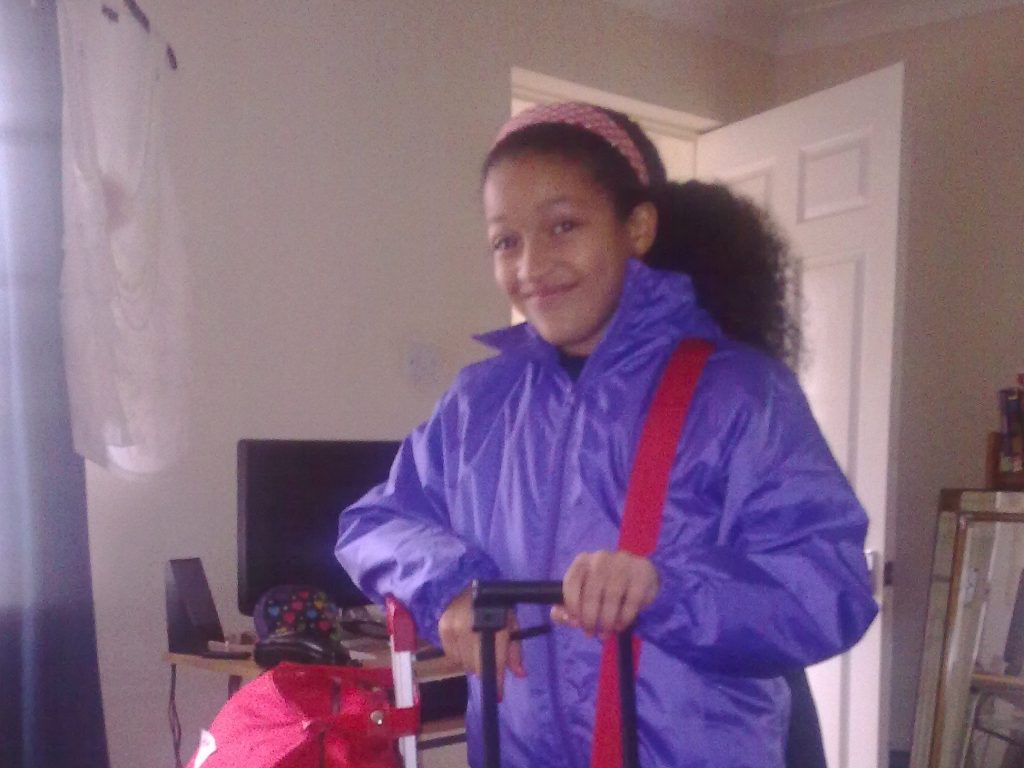
My voice has been a site of contestation throughout my life, particularly during my adolescence. Though I speak without impediment, it’s the ‘accent’ that particularly throws people. Once in primary school, a boy who would often pick on most of the inconsequential things I did (young love), told me that I talk like I’m singing. I stopped in my tracks, not sure if it was a compliment or cuss, though assumed it was the latter. Later in my teens, I shied away from sending voice notes and disliked how my voice sounded on camera, high-pitched and overtly ‘girly’ with fluctuating intonations which I was especially self-conscious about.
In primary school, during year 4 I had a teacher who disliked anything I did. Her and my mum would regularly bicker outside of my class. She was callous, uncaring, and frankly, racist. This was made glaringly obvious by the fact that for Multiculturalism Day she made our class of 30 colour in only Welsh flags as our year group contribution. She told my parents that she had referred me to a speech therapist because “I talk like a child”. I was nine years old. My mum was horrified and refused to let me undertake the assessment. My Dad reasoned that if I went and sat the test, though it was obviously a waste of time, it would prove that this teacher was unnecessarily picking on me.
My mum eventually agreed, and they both came in the day of the assessment. The speech therapist found no issues with the way I spoke and wrote in her assessment that she found it questionable I was referred in the first place. My mum still has the letter packed away amongst my childhood memorabilia, occasionally bringing it out of its protective plastic wallet to reread it and shake her head. “That racist cow”.

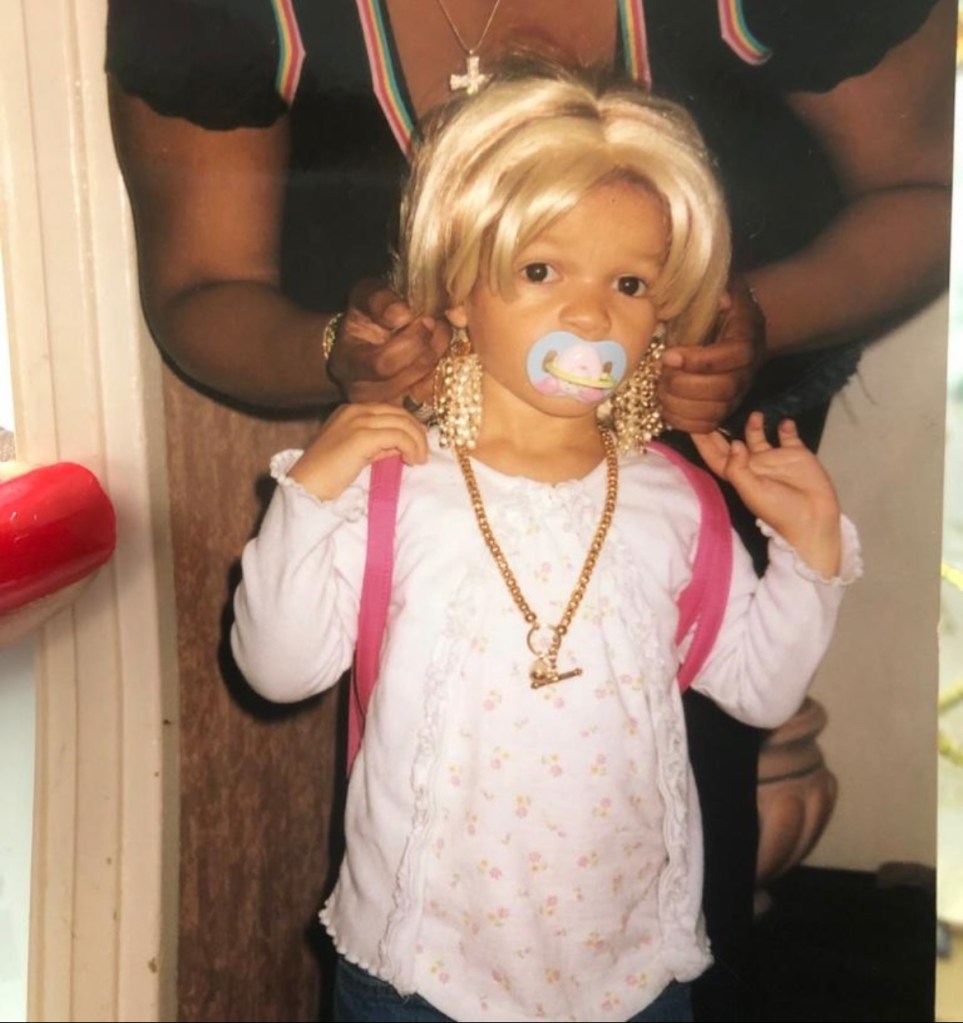
My teacher was really beefing me when I was this small
Today, when greeting customers at work I will invariably get questions about where I am from. Canada, America, and to the amusement of my colleagues, the Midlands, have been some of the said customers guesses. “I’m from south London” I always reply. This usually leaves them in a state of bemusement. Sometimes they will then copy the words I next say to them, as if trying to make sense of it, which always irritates me.
Growing up as a kid watching nothing but Disney channel can perhaps explain American tendencies in the ways I say certain words (though I don’t think I sound American at all). Dosed up on Shake it Up and Bratz movies, my cousins would often tease me as a kid about my voice during their visits. “Why do you talk like Barbie”, the younger one would say, in his most indulgent ‘Valley girl’ impersonation. “No, I don’t!” I’d enthuse, just to hear it said back to me in a caricatural American accent.
Tracing my tonal genealogy can provide some answers. Both of my parents are from southeast London, growing up just short bus rides away from each other. Both working class, and one with immigrant parents, you’d think we’d all sound the same. My mum carries more of a south twang than my Dad, heavily shaped by her cockney parents. My Dad, with Bajan parents and soft spoken like me, I believe has more of a general southerner accent. You wouldn’t necessarily pin him down as a Londoner from first impressions alone, but as he’d speak more, London language (theorists call it Multicultural London English) would rear its head.
An amalgamation of this and the fact that I grew up with a Northern stepdad until I was fifteen and saw my Bajan grandparents each weekend, their voices thick with a country Bajan lilt and accompanying ever-rising intonation, can explain why perhaps I don’t sound like your average Londoner. Cockney rhyme, patois (from MLE) and general Bajanisms were the dominating soundscapes of my youth. I was bound to pick up various cadences along the way.
Another factor that can be attributed to the surprise when I start to talk is that my voice contradicts assumptions made about my class. Going to primary school in an increasingly affluent area in which the working class and non-white were phased out with each school year meant I invariably built a friendship group to which more than half were middle class. It also meant their speech codes rubbed off on me.
My two best friends in primary school were white and especially middle class. Their parents worked in art, education or the charity sector. They had tutors, au pairs (a term I hadn’t heard of prior to my friendship with them) and called dinner ‘tea’. Their houses were bigger than mine, and this was often why I went to their house after school instead of inviting them to mine. In turn, I developed some middle class sensibilities so different to my true class identity.
I later realised it was part of my mum’s plan all along. My mum grew up hating school, she is dyslexic, didn’t get the help she should have, and frustration grew from a lack of understanding. The British education system is pervasively classist and offers little grace to those it deems unworthy of help and incapable of achievement. The ever-widening educational attainment gap between classes speaks to this. Though cultural attitudes can have a part to play, it is largely reflective of systemic discrimination against pupils belonging to the working and the lower classes. Her worst fear was for her children to have the same experience of the education system as she did, and so it was her mission to mitigate against this.

My Nan, shortly before she left school
Neither of her parents placed much emphasis on the importance of school or educational attainment, a reflection of both the times they lived in and larger class attitudes towards schooling. When money needs to be earned to support your family, schooling seemed somewhat frivolous. This is evident in the fact that my Nan left school at 14 to work, as did my Grandad, also pursuing labour over learning.
My mum wanted it to be different. She would list the private schools she would have sent me to if she had the money, getting lost in her own version of a middle class fairytale. Dreams of social mobility. Learning would be a focus; cultural capital would be maximised. In my childhood we frequented libraries, museums, gallery exhibits, and I was prompted to learn the piano, my brother, the violin. They were gestures of status. Whilst pregnant, she played classical music to her bump, having read research at the time that argued it aided brain development. It is a feature of her pregnancy story she loves to tell.
When the opportunity to take Latin presented itself in secondary school, my mum answered for me. “You’ll do it Chloe” she said sternly, I said I’d enquire, though I knew Spanish was already enough, and truthfully, I didn’t want to give up my evenings weekly to study it after school. To this day (along with eventually giving up piano lessons), it is something my mum cannot forget. To her they were tools to elevate above the drudgery of our class, a method of climbing the social ladder through instruments and classical knowledge. Equally, they were opportunities that she as a child never had, and it was a kick in the teeth to pass up on them.
I was to adopt the middle class habitus as my own, even though it wasn’t my actual class identity. That was the way to get a seat at the proverbial table. Sociologists like Bourdieu argued that the education system favours middle class habitus (set of attitudes, values and practices that shape an individual), and so middle class kids already have an advantage and subsequently succeed throughout the education system. Success is theirs for the taking.
My mum echoed this sentiment. She gleamed when I accompanied her as a child to my Godmothers birthday party and a mutual friend, who after hearing how I spoke, asked if I went to a private school. “Oh, no” she chuffed, feeling proud. Her daughter was articulate and well spoken, did not speak with a cockney charm like that of her own mother, and to her, it was a job well done.
The way I speak in part deceives the listeners and that is why I am often met with confusion. There is of course a racial layer to this, the issue of ‘talking white’. Memories of my GCSE English oral exam in which my speech spoke to the ‘difficulties of being mixed race’ are flooding back. Don’t worry, this is not about to unfold into a case of “too white for the Blacks and too Black for the whites”. I’ve never felt such a feeling. However, the notion of ‘talking white’ was seared into me throughout my teens. It is the closest I got to an identity crisis.
Affirmed in my Blackness and dual identity throughout my childhood, I felt that my voice let me down in a sense. I’m not the poshest girl you’ll ever hear by any means, but my speech led me to have to justify my Blackness. To prove I was in touch with who I was despite it seeming to the contrary to my peers because I sounded middle class, and therefore ‘white’. Both classed and racialised ideas about how I should sound permeate through people’s assumptions of me. These days when I am met with ignorance, I know it is a reflection of them and not me.
*
I love being out or at work and picking up a Bajan accent. I defend it religiously when other (usually also West Indian) people mock it’s lyrical cadence and heavy rhoticity. My Gran’s voice is the sweetest to grace this earth, and so the Bajan accent is homely to me. I love watching Eastenders whilst me and my Dad put on our best East End accents, imitating Phil Mitchell or Billy. My Dad adored my Nan’s cockney accent for all of its matter-of-fact quality. There’s a whimsy to cockney sayings that are hard to find in other regional idioms (‘up and down like a bride’s nighty’ is my current favourite, as is, ‘[they’re] as thick as two planks’). In saying that, you also can’t beat the way Northerners say ‘bastard’. I have my stepdad to thank for that.
Once the cause of my insecurities, I am happy with how I sound and have been for many years now. My elusive ‘accent’. The flurry of accents that informed it have imbued me with great vocal range. I think it charms, or so I hope. At least you can spot my laugh out from a crowd, and it beats being monotone. Yes, I may sound a little posh, but it was really my mum’s wish.

 Queencoc0 Talks
Leave a comment